"Plant Dreaming Deep"

"Plant Dreaming Deep" is the title of a journal by the poet, May Sarton. In it, she details her restoration of a house in New Hampshire where she began planting what turned out to be a series of spectacular gardens.

I read over the lists of flowers and trees she chose, my lips moving silently, as if I was reading over a mouth watering menu. When I first read Plant Dreaming Deep many years ago, it was my safe place to go, my retreat when it seemed like the critiques and sharp barbs of graduate school threatened to tip over my craft.

I'm closer now to May's age when she began her journal and I've turned my mind to a dream of my own planted those many years ago; botanical drawing.

I'd heard of botanical illustration and wanted to take a class, but never did. 30 years later, flipping through our art center catalogue, I read a description for a botanical drawing class. It noted that  "The emphasis will be on careful observation of our subjects with a playful, open-minded approach."

The words playful and joyful hooked me (because who doesn't need more of that?) and I arrived at the first class, my DeYoung tote bag filled with bright and shiny art supplies including sumi ink brushes, bamboo pens, waterproof black ink and a thick black bound journal of creamy watercolor paper.

Our first class began with a blind contour drawing of a flower--a multi-floral rose. Now you need to know that drawing is not my strongest suit. I studied it, took classes in it, but its finer points have always eluded me.

Stacey, my friend and instructor, advised us that we should approach the flower as if we were taking a trip with our pencil, curious about each bend in the road. I gulped, began--and loved it.

Stacey emphasized the practice of non-attachment to the results, straight out of Yoga and Buddhism. I could relate to this. I found my pencil slowly wandering along the petals, getting lost in the contours and subtle serrations of the leaves.

I was surprised how quickly the time passed and surprised too by the result, the wavering lines which overlapped and crossed each other, nonetheless conveying the feeling of a rose.

As my pencil continued to explore, I felt extremely relaxed and peaceful, a kind of peacefulness I hadn't experienced for some time and to which I connect the feeling of meditating. Meditation--one of those activities that I know is "good for me" but is hard to get to. The way my mind can spin! But with this drawing, there was none of that, no swirl of thoughts that accompanied my sitting meditations.

Could it be that I had found my own form of meditation? I'll find out as the class continues, but for now I'm resting my mind in the luxurious feeling of my sumi brush as I slowly brush the ink onto the paper. I've found a retreat. And I think I'm going to go back and reread Plant Dreaming Deep.

Happy the man who can long roaming reap,
Like old Ulysses when he shaped his course
Homeward at last toward the native source,
Seasoned and stretched to plant his dreaming deep.

-May Sarton, after Du Bellay

Sneak Peek and the Last 2 Questions

Here we go: last thoughts on this matter of Lessons from Things.

5.) Can you provide a little information or "sneak peek" on the pieces you've included in the show? (I.e., how long it took to make, what materials you used, etc.)

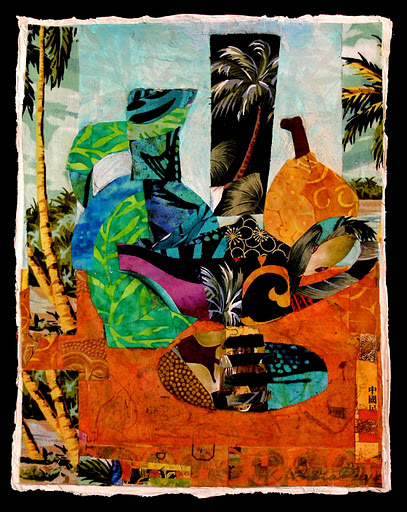
The Power of Desire, ©2010, collage

I've been working on the pieces in the show for about a month. If I had to break it down, each piece probably took about a week in time, although some came quickly over a number of hours and others over a period of days. Over the years, I've created a studio practice, spending several hours in the studio each morning before I shift identities and change from an artist into an artist therapist.

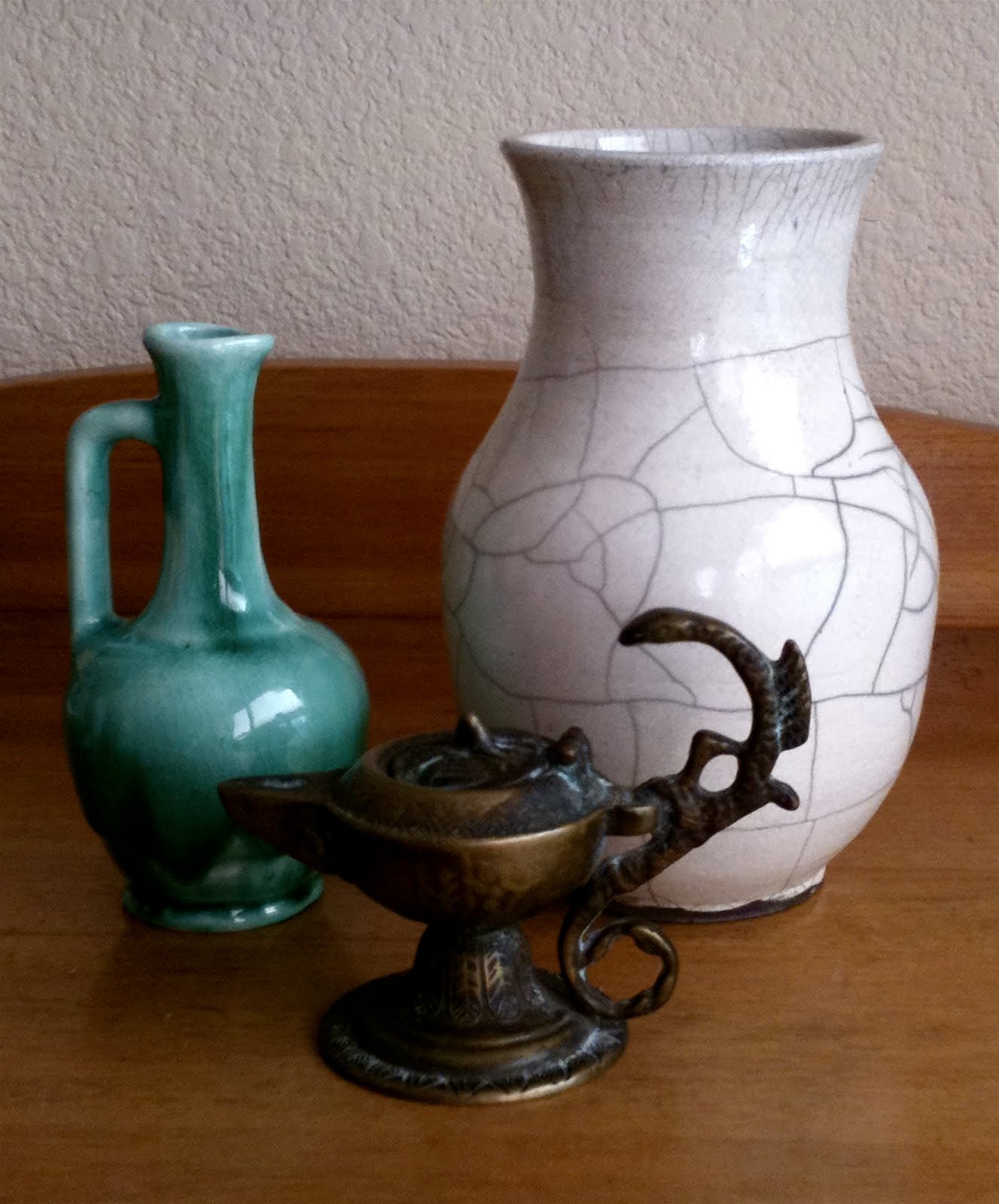
When Sara asked us to provide an image for the show, I put together a still life of objects from around my home that I love: a white raku vase, a jade-colored porcelain beaker and a palm-sized, brass Aladdin's lamp. Although I began with what I thought was a traditional still life approach, it quickly morphed into an exploration of the shapes through juxtaposition of fabric and paper, trying to create animated but believable forms. It was a lot of fun.

6.) What would you say to all of the other aspiring artists out there?

I had difficulty with this questions because it seems to presume that  I've arrived somewhere when, in fact, I feel like I'm constantly striving myself. The answer below is what I deeply believe.

Persistence, persistence, persistence. Very little happens overnight and real progress occurs over years. Never give up. Always believe that you have a unique voice, unlike any other artist. Have the courage to believe in this voice. Malcolm Gladwell makes this point about persistence in his book The Outliers. In it he talks about the 10,000-Hour Rule, saying that the way to success in many fields is, to a great extent, based on practicing a specific task for a sum total of about 10,000 hours. I haven't been counting--but I may be getting close.

L'Eau de Vie, ©2010, collage

 For the complete article as it appeared in the Monday edition, check out the California Aggie.

Fresh Impressions: Part 2

Today's Part 2 focuses on the exhibit, Lessons from Things and the process of working on the still lifes that are part of it.

3.) What makes this exhibit stand out from others that have happened here locally in Davis?

Sara Post has gathered a wonderful group of artists together and given them a traditional subject, namely, familiar objects, and added a twist that is particularly hers, looking at art-making through the lens of another culture.

"In our object-rich culture, there is a tendency to skim over the presence of things, to cease to see them because of the sometimes overwhelming amount of objects in our lives. This exhibit offers an opportunity to slow down, to focus, to be with and perhaps to add to our understanding and enjoyment of objects that surround us," notes “Lessons” curator Sara Post.

Within the structure of the exhibit, she weaves in an educational component, so that the viewer comes away with more than an encounter with the works of art themselves. The unique quality of Sara's lively and provocative themes set her exhibits apart.

4.) What do you hope to gain from the exhibit (in any aspect, whether, spiritually, emotionally, or if more aimed toward the community)?

Lake Okoboji, ©1977, watercolor

The greatest gift so far took place in my studio. In order to create these still lifes, I've been reaching back into my days as a young student and drawing on my youthful enthusiasm. It was a magical time; so much seemed possible and everything was fair game for the canvas: a plein air landscape, the view from my apartment window, pieces of fruit placed on a worn wooden table.

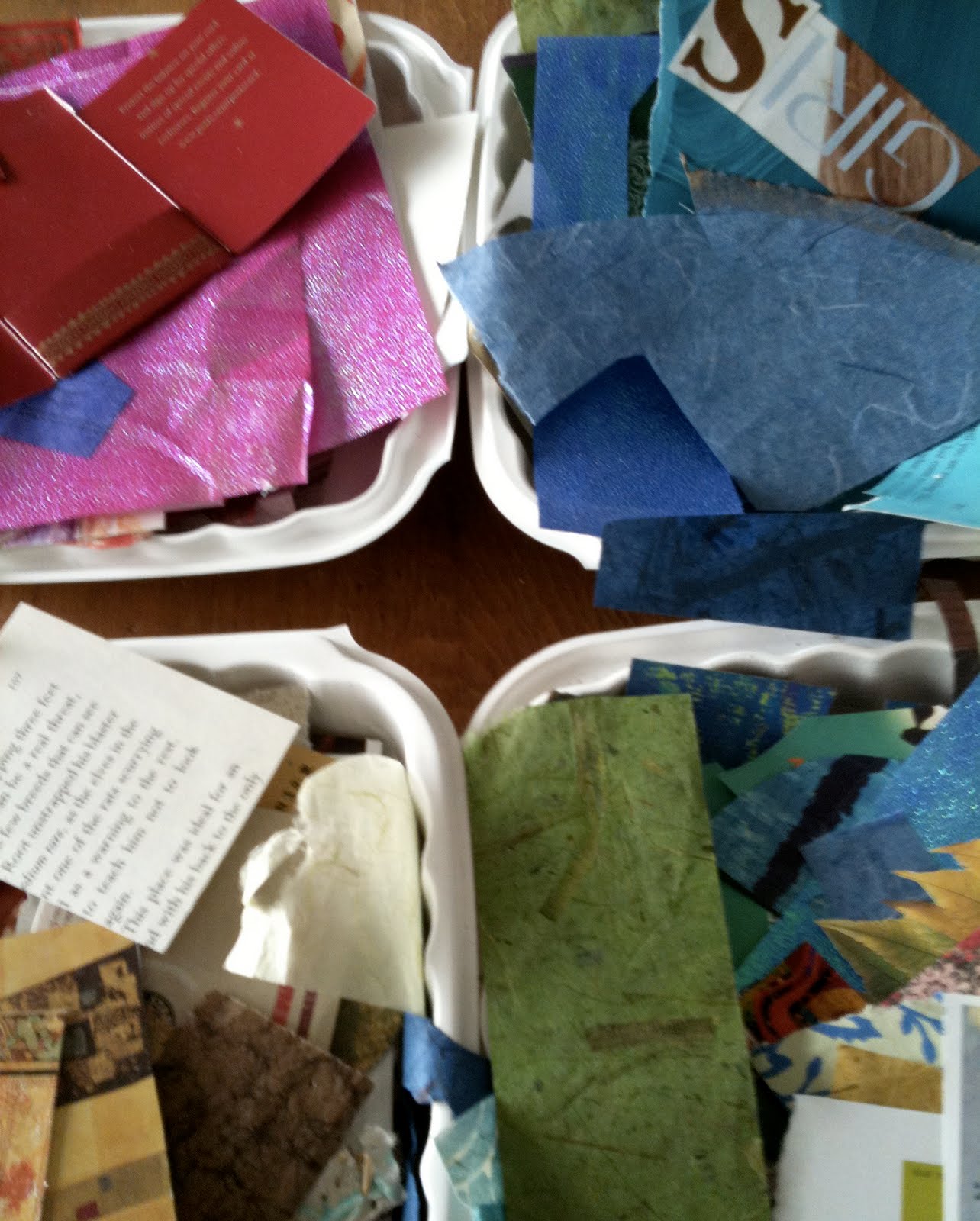
Recycled take out containers for colored papers

As I've re-explored the subject of still life, I've been able to tap into that enthusiasm and ebullience. But there's a twist. I am older and the experience of the life I've lived since that time filters into these  collages as well. I see it in my approach; the willingness to take the objects I've studied "out of the box" and off of the linear plane. I experiment more freely with media and feel  confident in the way that I handle the colors and patterns; letting them come together in a sort of seeming randomness that is actually the result of working with composition for so many years.

The beige take out container has it all

I also look forward to the reception for the exhibit, to those equally random moments when I watch other people study the artwork on the walls and hear their exclamations as they move around the gallery. I love seeing so many people that I know from so many times of life here in Davis. I've never lived anywhere as long as I lived here: 22 years. That creates a rich tapestry of friends and acquaintances and you never know whom you're going to run into or what you might end up talking about. Perhaps I'll meet a new artist friend or even find the thread for a new series of collages.

Fresh Impressions: An Interview in 3 Parts

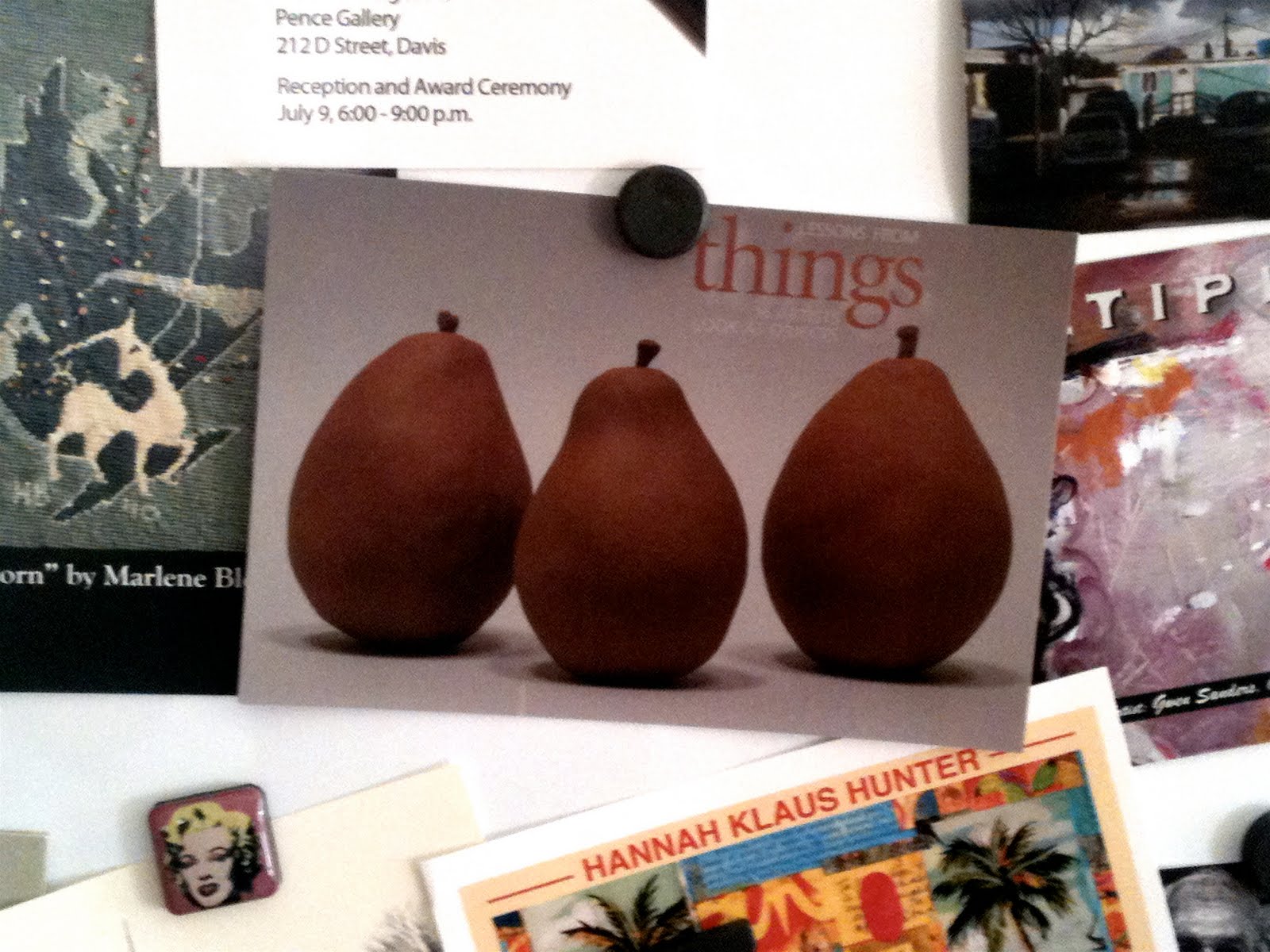
Lessons From Things, postcard front on the "fridge" gallery

I've been working on a series of still lifes for a group exhibit entitled "Lessons from Things" at the Davis Art Center, in Davis, CA, 
August 2 - September 3.


Last week I was approached by Lea Murillo, a reporter from our University paper The California Aggie. Lea asked me if she could interview me for the exhibit curated by Sara Post.

I embraced the invitation, knowing it was one of those opportunities that Alyson Stanfield, in her book, "I'd Rather Be in the Studio," recommends for those of us who prefer to hang out with our paint, paper and brushes rather than write about them.

I'm reprinting the questions and my replies in the next three posts, because most of the time, I don't get the chance to read what an artist has said as he or she said it--simply because another person, the journalist, is doing the writing.

Lea asked me to answer the questions according to how they apply to me, the exhibit, and the connection between the two. Hence the segue between myself and the exhibit.

 1.) How long have you been an artist and, what does your artistic background consist of?

I've thought of myself as an artist since the age of 21, 33 years ago now. I received a B.A. in Studio Art from the University of Iowa (where I spent most of my time in the weaving studio) and an M.F.A. in Textiles and Sculpture from the California College of the Arts (where I spent much of my time crossing the campus between the Textile and the Sculpture studios).

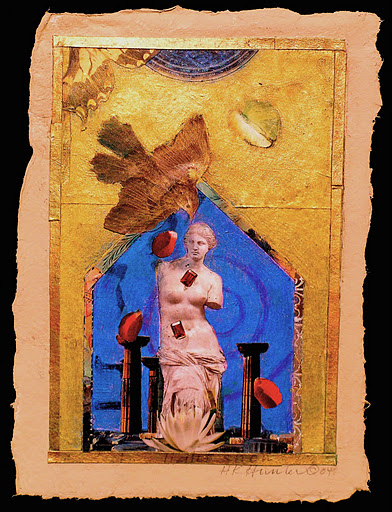
Tempting Fate, ©2004, multimedia

I've always been interested in the intersection between media so that in both undergraduate and graduate school, I focused on textiles, painting, writing and sculpture.

Throughout my career as an artist, I've tried to blur the lines between the disciplines, or, another way to say it is that I try to find the liminal zone where two or more media come together.

When Sara curates an exhibit at the Davis Art Center, she engages in a similar quest; she becomes interested in a particular area, such as collage, and offers artists an open range for exploration.

In the current exhibit, "Lessons from Things," the title immediately produces a cornucopia of ideas. According to Sara, the title "refers to what was once a part of the French primary school curriculum—the study of things or objects and how they came to be what they are—their history, their evolution, their uses. It is a way of looking deeply into an object and seeing what is there."

That same title takes me back to first grade when I learned that a noun is a person, place or thing. From there, I begin to think about how I want to document some "thing," which leads me to thinking about which "things" in my environment inspire me.

2.) What inspires you?

Baby pomegranate

I spend a lot of time studying the natural world around me: ripening fruits, flowering oleanders, rows of sunflowers, furrows of rice fields off the causeway. 

Oleander on the way to work

                  I also love to study patterns in architecture, quilts and words.
      

Dancing Ring, ©2009, quilt

                   I distill all of these observations into the form of a collage.

Twins, 1 ©2009, collage

I also draw inspiration from my work as an art therapist at the UC Davis Children's Hospital. Much of my recent work (although not in this exhibit) is a response to my involvement with various children and their effects on my life.

More to come tomorrow. I'll be posting about my experience of working on the still lifes. 


A Code of Many Colors

Every so often, the worst thing imaginable happens. A woman's voice says in clear distinct tones: "Code Blue, Davis 7"

My heart skips a beat, waiting to hear the floor. "Please," I say inwardly, "not Davis 7."  That's our floor, the kids' floor.

Code blue is called when a person's heart stops beating. Doctors, nurses, a pharmacist and a respiratory therapist are paged to do their best to revive the patient.

From the point of view of the people involved, it's a team effort. From the point of view of an observer, it is an otherworldly event. When it is successful, the rest of the day is spent picking up the pieces, literally and figuratively.

A code blue took place on our floor recently and by great good fortune, the patient was revived.
In this instance, as an art therapist, my role is strictly that of the picker upper, one of many who helps put the pieces back together for a family. In this case that meant working with one of the child's siblings, a ten year old girl.

I looked into my internal Mary Poppins bag of tools. What to do? What project would allow this child to process the swirl of emotions taking place inside of her and yet preserve her dignity, her anonymity? 

I came up with the "Inside Outside" box. It's a standard art therapy directive, using collage materials; magazine pictures, Mod Podge, buttons, gems, pipecleaners, stickers, feathers, small wooden tiles (everything but the kitchen sink.)

We spread these materials on a table along with small boxes. The idea behind the project is that you put images on the outside of the box that express the part of yourself that you feel comfortable showing the world, and on the inside you place those images and objects which are private; images that represent the parts of yourself you might share with family or friends, or perhaps no one.

I watched amazed as this girl took the small tiles, carefully wrote the name of each of her family members and added a colored gem to each tile. She then glued them to two sides of the box and added some feathers on the opposite sides. It looked very ceremonial, like some kind of memorial marker.

Next, she turned her attention to the inside. I looked over as she was about to flick the contents of a brush heavily loaded with chartreuse green paint. "Whew!" I thought, "caught her before that went ALL OVER everything." Knowing she had a huge amount of emotion stored inside of her after the code, I taught her how to "point and flick." She spent the next half hour flicking every color of the acrylic palette into the box. I could not have imagined a more perfect way for her to express and capture her fear, helplessness and uncertainty.

That's the magic of art therapy. Behind a seemingly simple set of directions, lies an opportunity for a person's psyche in a pure, uninhibited yet protected way. (Provided these simple directions are supported by appropriate training in art therapy). It's one of those moments where all the study, hours of supervision, and my effort to keep faith in the process bears fruit.

Perhaps fruit isn't the right metaphor. I'm a Virgo, one of the most service oriented signs in the zodiac and I'm guided by the one of the tenets of my Jewish faith, "tikkun o'lam, " which means repairing the world. In a vulnerable moment like this one, peering into this small maelstrom of a box, I feel a piece of our world has been mended.

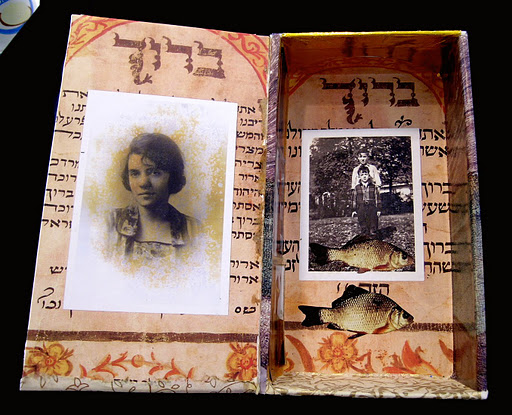
Pictured above is one of my first "Inside Outside" boxes made in 1999 during a class in medical art therapy.  I call it "My Father's Box."