Young Adult Bereavement Art Group / Art Therapy in Action

Ceramic Grief Mask, Hannah Hunter ©2009

It's February and that means time for the winter session of YABAG--or "The Young Adult Bereavement Art Group". It began in 2009 as a collaboration across disciplines to serve young adults ages 17-24, who have lost a loved one. It has grown from an isolated observation into a dedicated vision of how to best serve this population niche, sponsored by UC Davis Children's Hospital and UC Davis Hospice.

The group started when someone in our Children's Bereavement Committee commented that there were no art therapy bereavement support groups for people this age. The heads at the long conference table all turned toward me. Me? Didn't I have enough going on? However the prospect of beginning a program is something I find irresistible and I was soon on board.

A neonatal nurse, pediatric social worker, hospice bereavement coordinator (tongue twisting titles-good peeps) and I began to meet and over a period of several months and planned the group structure, curriculum and found funding. Our first group met in February of 2009 and my world cracked open.

I and my co-facilitator, a man of great humor and compassion, found ourselves in the presence of persons who were grieving losses by more causes than we could have imagined. We discovered that what often gets individuals of this age to a support group is the confluence of tragic circumstances.

What we also discovered was the openness of these young people show toward one another. Once these young people show up, what follows is honest and inevitable. Our program takes them and us through an 8 week journey of art and talking and listening, all designed to parallel the grief process.

We've worked hard to spread the word about this program; seeding the local universities, community colleges and high schools with fliers and reaching out to police departments, therapists and social workers.

It takes time for word to take hold and grow roots. YABAG is offered free of charge and meets from from 6:00 - 7:30 p.m., beginning Monday, February 28th and concluding Monday, April 11th.

If you know of anyone in the Sacramento area who might benefit from this work, please contact us for more information at 916-734-1139.

Close to Home

Sara Post, Redwoods, ©2011, oil & cold wax

Last week I had the occasion to attend an opening for an artist friend whom I've mentioned frequently in this blog, Sara Post. Sara's exhibit, Close to Home, was up and ready to see in our local Davis, CA gallery, the Artery.

I had a particular curiosity about this exhibit because Sara had confessed to me over coffee several weeks back that she had one month to come up with the artwork for this show. When she told me this, I knew for a certainty that she would take the proverbial tube of paint and run. And run with it she did.

A couple of weeks later, I stopped by her house to drop off a book. When I walked into her studio, work was spread over the tables, hanging on the walls and arranged on the floor. Joyful abandon reigned supreme.

Sara Post, Sprinklers, ©2011, monotype

I'm fascinated by how specific conditions such as an imminent deadline can elicit completely different creative responses in people. Sara decided to look no further than her own backyard for inspiration.

A wise choice judging by the results.  Sara honors the beauty of houses and gardens and the fascination that we bring to them. It's as if she's taken a magnifying glass to the world outdoors; exploring walls, windows, doors and rooftops; the spaces they create and the landscape they define.

Her work places itself in a tradition of modern landscape painters such as David Hockney and Cy Twombly.

Untitled_secsplsh.jpg
Cy Twombly. Untitled (detail), ©2007

As I gazed at the pieces I found myself drifting into an imaginary back yard where pools of deep turquoise water drifted in and out of focus and grasses blew in the wind, waving their tips of gentle gold.

I crisscrossed the gallery, picking up one observation here and dropping another there,  imagining the possibilities that my own back yard might offer.

Sara Post, Flags, ©2011, monoprint

If, as Voltaire says in his novel Candide, "we must cultivate our own garden," this exhibit invites us to explore the abundant possibilities which may lie therein.

State of the Heart

Shades and Tints

Valentine's Day approaches and I've found no better place to celebrate it than in the playroom of our hospital. It's a place where even the most jaded of hearts opens wide. For someone dedicated to the practice of maintaining an open heart, well, it's a gold mine.

To begin the festivities, I set out materials on the art table--scissors, glue and paper plus the exotics: papers printed with designs inspired by Kente cloth, Japanese silk fabric and Navajo rugs. For good measure, I added ribbons, sequins and pom poms.

Once we'd made our way through decorating some 50 or so empty glove boxes, we began to make Valentines and met up with the good old shape of the heart. It doesn't escape me as I'm writing, all the double entendres that pop up around hearts and hospitals: open heart surgery, infectious love, heart-felt emotions, heart palpitations...etc.

Fortunately, the kids put all that to the side when they come in, dragging their IV poles behind them. They just get to work like the serious artists they are. These last two weeks brought several Spanish speaking girls to the group together with their moms. At the beginning of our time together, they were all so shy, they would simply nod "yes" and "no" to my questions. Any attempts to start a conversation simply died away. I invited the mothers to join us and they also nodded "no" politely but firmly.

Glove boxes transformed

That lasted all of two days, when I decided to throw in a twist and add the concept of shading and tinting to the mix. Using oil pastels, I asked them to draw a heart and to color the inside of the heart one color and the outside of the heart another. The next step was to use a ruler and draw several lines that bisected the heart, going from one end of the paper to the other. This resulted in "a heart divided." Finally, I asked them to use a gray pastel to add shading to one half of each segment and a white pastel to add tinting to the remainder of that segment.

A great idea in theory, but I forgot to factor in manual strength. None of the kids present had enough physical strength to color in the outside. The moms took action. They couldn't let their children's hearts go empty. They each pulled up a small child size chair and began to color. It was only one more step to accepting papers for themselves and taking off on their individual heart.

By the end of this week, we'd made jewelry for the occasion and added several other young children to the mix. The girls were positively bubbly by now. Another Spanish speaking mother arrived with her able five year old boy and complemented me on my Spanish (which honestly is still limited to something like "quieres hacer un corazon?")  I was touched and even more so, because after spending this time together, we had created our own community and as far as "making hearts," they had certainly made mine and it was wide open.

Taking Hold of Uncertainty

"...vision is always ahead of execution, knowledge of materials is your contact with reality, and uncertainty is a virtue." Art and Fear by David Bayles and Ted Orland I've been following these words as I work on a challenge for an art quilt exhibit I'm participating in.

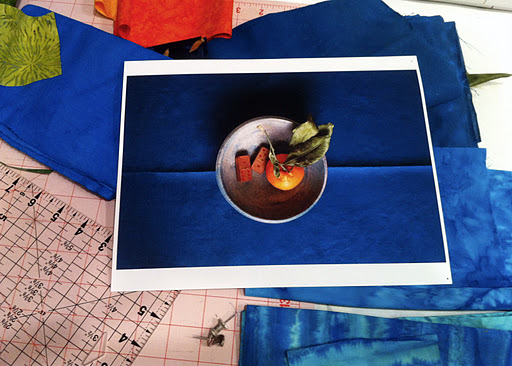
Our group of artists agreed to pick a photograph, which each of us would interpret in her own way.

It made me think of women quilters back in the 19th century, spurring each other on to greater heights of inventiveness, as they watched their neighbors take the same old shirt fabric and use it in entirely different ways.

We chose a photograph taken by Maura McEvoy, a stunningly simple shot of a mandarin orange and two dominos, sitting in a raku fired bowl on a deep teal colored linen background.

My first thought was to get as far away as  possible from the photograph and create a quilt that looked nothing like it. Then I careened back with an almost comical desire to imitate the photograph in a very literal way.

Frustrated by opposing impulses, I decided to channel my imaginary 19th century ladies.

It seems to me that these women were the early forerunners of color theorists like Josef Albers, employing an understanding that colors appear differently, according to the colors  around them. The use of color in a pattern created the spirit of the quilt.

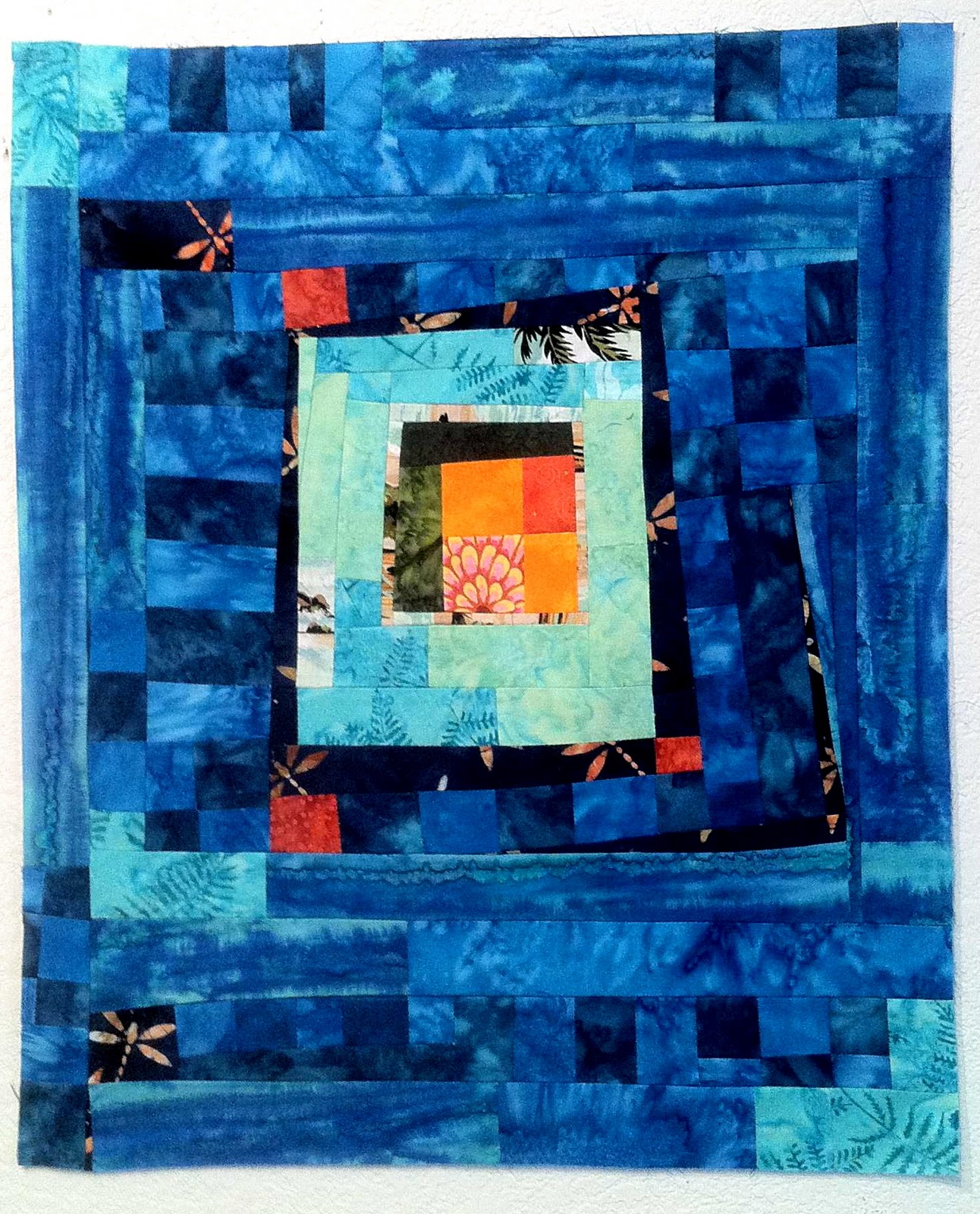
Although I'm no slave to pattern (I usually want to break it as soon as I begin), I wanted the blues of my piece to pulsate around the squares, suggesting the delicate cracked bowl with the bright orange mandarin and the ochre colored dominos.

One week and many stitched together scraps later, I've begun to enjoy the process; stepping into the unknown, unsure of where the next stitch will take me and also not knowing exactly where the final stitch might reside.

Thinking of my ladies, both the real and the imaginary, I'm discovering the loveliness of uncertainty.

Color: STAT!

Thinking in Stripes (before quilting) ©2011, Hannah K. Hunter

About this time of year, I begin to get a bit squirrelly, especially with the tule fog of January (and February and March).

This dense fog, named for the tule grass wetlands of the California Central Valley, makes me feel cozy at the beginning of the season, all tucked into whatever world I happen to be occupying. But like snow in colder climes, the pleasure soon begins to gray.

I long for big splashes of color, wide skies of brilliant blue and the glowing yellow sunflowers of summer. Looking out the window this morning, I knew it would be awhile.

Of course, there is a cure for this: the studio. I go in and I want to inhale great gulps of color: carmine, fuchsia, tangerine, chartreuse, coral, jade and emerald green.

I've been working on a full size quilt for an upcoming exhibit. As I tried to work out the pattern for it, I began a smaller piece that could capture my color hunger and satiate it at the same time. I wanted the quilt to be irregular, with large "bites" of color, color that could explode inside me when I look at it; the same sensation that a child might have when she pops a Starbursts into her mouth and savors the eruption of harmonic sweetness that follows.

How are you coping with winter in your domain?