unexpected moments, small miracles

IMG_1325During the winter holidays, our pediatric unit is festooned to the nines in greenery, glittering balls and ornaments. Stately trees decked with stuffed animals and toys grace each alcove on the floor. In my early days here at the hospital, there was always some acknowledgement of Hanukkah too; a garland of dreidels or decorations made of cobalt blue and white. This week marks the beginning of Hanukkah, the 8 day Jewish festival of lights and it's been a long time since I've seen any blue, white and gold decorations on our floor. By the first day of Hanukkah, I was growing weary of Santa visits and a pervasive sense of Christmas as the ruling paradigm. I didn't think I could do anything about it;  I just observed my irritation.

But later that day, one of the nurses came up to me saying: "A surgeon just called me and asked me if the Art Lady could come up with some kind of Hanukkah decorations. The surgeon is Jewish, it's her birthday and every time she comes on our unit and sees only Christmas decorations, she's sad."

Was the doctor reading my mind? I decided to make some decorations STAT in Art Group, although I was a mite concerned about parents becoming upset when their little girl or boy set to cutting out Stars of David or dreidels.

And that's when the tiny miracle happened. That afternoon, most of the children were confined to their rooms on isolation, but one family staying close to the playroom rolled in. I explained that we were making a paper chain with stars for Hanukkah. They became very excited, sat down at the table and the dad asked me "Do you know why they use that dark blue for one of the Hanukkah colors?"

He explained that the cobalt blue was inspired by a kind of dye that was used in ancient Israel. I was impressed, especially when he told me that scientists were still trying to figure out the origins of that dye.

A wonderful hour of linking one paper ring to another followed, with stories and memories exchanged. More people came in and they too, got excited. When we finished, we had a 30 foot-long chain dripping with brilliant yellow stars and blue rings.

I gathered the collection of stars and rings in my arms and carefully placed them in the nurse manager's office. When I arrived the next morning, I wondered whether they would still be sitting there or hanging in the entry way. I entered, turned around and saw them, signaling in their unique way, the miracle of the season.

The world has, for far too long, traded upon exclusivity instead of inclusion and it seems to me, that at this time of year, is there any better time to honor our traditions? Everyone's traditions.

Open Studio as a Practice

Nandina 1, ©2014, 8" x 10," Monoprint on panel When you're in a yoga class, the teachers often refer to "your practice," a phrase that both personalizes one's practice and places the responsibility for it squarely on one's shoulders (or should I say palms and feet?) When  my teacher was directing a complicated pose the other day and used the phrase "if you have it in your practice," those words that simultaneously reassured and challenged me.

I'm taking them to heart and applying them to an event that's just up the road, my first Open Studio event in several years. I always get excited about the idea of an open studio, but as the date gets closer, the idea of opening my house to people feels like the proverbial dream where I look down and realize I've forgotten to put on my shirt. Exposed.

But here's the thing: I love being up in my studio and making my work, watching it fill up the walls. But there's another part to the process of making art that I struggle with: sharing it. Its a way of completing the circle, to bring what is internal out and allow the world to see it.

I do want to share it, but that feeling of exposure is uncomfortable. And that's where yoga comes in. Perhaps, I thought, I could see the whole thing simply as a continuation of my art practice,  something that is actually a natural extension of making the work.

In a practice, whether it's an art or yoga practice, the important thing is to show up. As I thought about this, I began to feel more confident and I got curious about this idea of practice. I read different yoga blogs to get a feel for what different teachers meant by practice. While they generally agreed on the physical benefits, I collected different tips about how to maintain a practice:

•Set an intention or goal and set aside time for that each day. • Stay positive -- know that it is possible. • Be patient with myself; honor my body. •Acknowledge my accomplishments, big or small. • Continue my practice. Combine these points with a heaping portion of non-judgement and compassion, and I've got a good recipe.

So far, so good. I've been staying tuned into Art Hannah. I think that the most exquisitely difficult and simultaneously most rewarding part of the practice is this: I can't make my art or my home or myself anything other than 'what it is' or 'what I am'Holday--and that if I am completely myself and my art is too, there isn't any better place to be.


Trust the Process

Recently, we had the third meeting of our Young Adult Bereavement Art Group. It's always a bit intimidating, having a group of young souls facing me, their faces carefully blank, but inside, a tangle of  sadness, exhaustion, frustration and hope. The challenge: Somehow we (my co-facilitator and I) have to create a pathway for some of these feelings to find their way out. One of the great tests of teaching is to greet a classroom day after day, seeing the upturned  faces that expect you to offer something that they in turn, can digest. Or not. Perhaps the most difficult challenge is to face apathy.

The main way I know these folks are not apathetic is that they keep coming back, meeting after meeting. Last night, we focused on identifying feelings related to their loss. The group went to work on a "feelings inventory," each one circling the little faces that most closely match their experience.

Next, and this is where my challenge came last night, was to take the most pressing feelings and fill in a body outline with color and symbols, wherever those feelings take hold in their body. I've explained this to groups many times, but somehow, the words I use to explain symbol and metaphor were not there. Only the symbols themselves.

I try to say enough so that their tap is turned on--but not so much that I get in the way of the flow. I hold up examples and talk about butterflies in the stomach and weights on the legs and padlocks on the mouth--and then I stop, almost holding my breath--and wait.

It's slow, they stare at their empty body outlines for a long time, unsure what to do first.  Some of them tentatively begin to outline their bodies in a dark viridian green.

IMG_2314

And then it takes hold, carefully and methodically the feelings pour through the markers in streams of red, black, green and orange. Tears are added, broken hearts appear and mouths wide open with shock.

But the greatest change is in the people from whose pens these feelings issue. As we go around the room, one by one each of them shares their map with the group. And the words which come out express relief, calm, contentment, curiosity.

I've heard it a hundred times, but the truth of it does not wear out: "trust the process."

The Head of a New Year

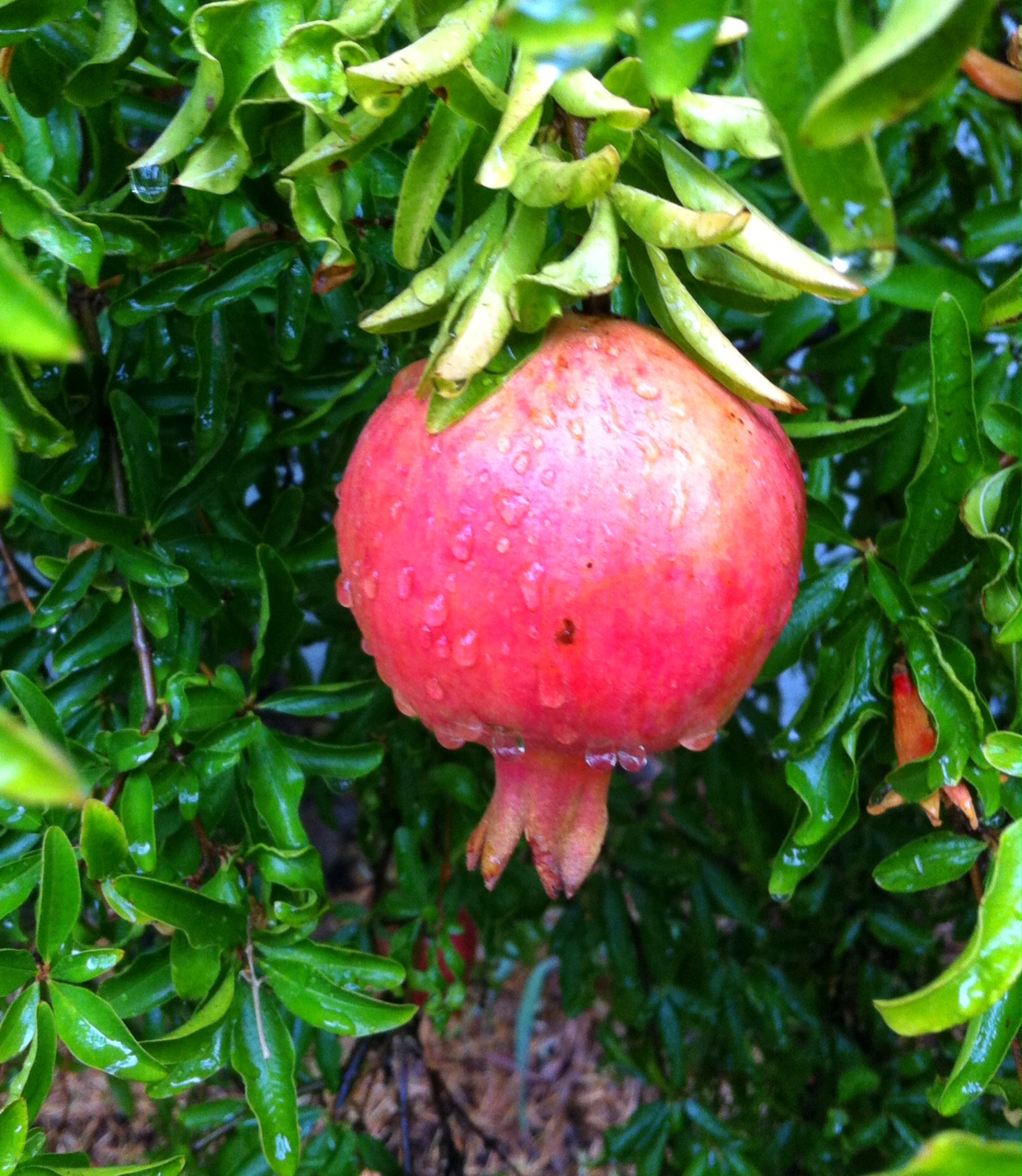
Pomegranate on the first day of the New Year 5775; the day of the first rain. This week marks the beginning of the Jewish New Year, Rosh Hashanah, or "the head of the new year," an important holiday on the Jewish calendar. It's the third day of the High Holidays (or High Holy Days), a ten-day period that ends with Yom Kippur—the holiest day of the Jewish year.

A time of reflection, we look back on the events of the past year, and our actions. Have we harmed anyone or anything? It's time to make amends, to forgive and to ask forgiveness. We remind ourselves, in a gentle way, not to repeat those mistakes.

It's also a time to open our hearts, to grow, even when the opening and growing is a bit tough. What an amazing thing; this holiday that aims to make us bigger hearted people!

In that spirit, I share this poem/prayer by Rabbi Ariel Levy.

As we stand on the edge of this New Year -- readying ourselves to cross over to what will be -- may strength and inspiration rise up within and around us.  May the skies inspire a vast perspective that opens us to new possibilities.  May the fires of devotion turn us toward each other with love.  May the waters remind us that all things change and we are part of the continued unfolding.  And may the earth shine its beauty encouraging our gratitude and dignity. Each of us is here for our short time.  May we live well what we love, offering our gifts and blessings for the well-being of all.   May this year show us the way to live in harmony and peace with each other and all the earth.   And may we help each other believe that this is indeed possible.  

Wish best wishes for a sweet and fulfilling year. May we live well what we love.

All Hands on Deck with Palliative Care

Change Your Buddha, ©2009, 6" x 6" x 2," Fabric Collage on panel Every so often, I think that it's time to take a break from my blog. This happens when I feel like I'm reaching for topics and even though life seems to be full of them, I can't see the forest for the trees.

What I know is this: I've got a presentation for our Pediatric Palliative Care Consortium here at UC Davis Children's Hospital that's scaring the pants off me--nearly. Because instead of playing it safe and using Powerpoints to hide behind, my co-facilitator and I are going to ask people to break up into groups and interact with one another.

That's not such an unusual thing in the art therapy world, but when you switch to the academic and medical world, there is an increasing distance between the tangible and the virtual.  In a recent New York Times editorial by Richard Kearney, entitled: "Losing our Touch" he notes,

In medicine, "bedside manner" and hand on pulse has ceded to the anonymous technologies of imaging in diagnosis and treatment.

All around us, we are showered with information from ubiquitous social media (of which this blog is a part), wherein we remain at a discreet distance from whoever is providing information on the other end. Now in classes, we often face computers instead of professors. And as you gain professional status, you frequently find yourself in your own office, trying to engage a in webinar, which tends to lull you to sleep rather than enliven the finer points of a subject.

During our part of the day, I want the participants to experience as much as possible, the kind of immediacy that occurs when one is faced with a palliative care patient; the overwhelming feeling of questions that you have no idea how to answer such as : "Is this diagnosis dangerous?" and reaching deep down for some untapped source of strength.

Full humanity requires the ability to sense and to be sensed in turn: the power as Shakespeare said, to "feel what wretches feel":--or one might also add what artists, cooks, musicians and lovers feel. We need to find our way in a tactile world again. We need to return from head to foot, from brain to fingertip, from iCloud to Earth. --Richard Kearney

To this end, we've reserved a room that has tables facing each other rather than toward the front of the room. We'll divide up into groups and tackle a case that involves the anticipatory grief that patients face upon diagnosis. Then we'll take that case through the course of an illness to hospice and beyond, to bereavement.

I hope to model the kind of direct hand to hand care that we want practitioners to offer patients. To do that we want to identify inner strengths, the qualities that each of us possess which allow us to enter tough situations and to be of service, no matter how daunting the circumstances. We'll lay out a banquet of images and after explaining a simple SoulCollage technique, we'llask people this question:

What quality do you call on within yourself to support children and families in their grief?

We'll invite them pick images that speak to them, to their soul, about the qualities that give them the strength and compassion to approach and support families and children at the this crucial stage of life. Can you imagine what will happen if we share these qualities with each other?