Reiki in the Studio

In my last post, "A Light Touch," I talked about the correspondences between practicing Reiki (a hands-on healing technique) and working with watercolors. (The Reiki Program at our hospital is directed by Kathy Lorenzato, music therapist and Reiki Master.)

The following week, the number of patients referred to me for Reiki treatments curiously multiplied and the week after that, there were even more. While I can see that Reiki clearly helps; patients quivering in pain slowly relax and fall asleep, even skeptical teens, who eye me suspiciously at first, doze off as well...I've become curious about how acting as a conduit for this mysterious energy affects me.

I notice that as energy pulses through my hands, it takes on different visual patterns in my internal awareness. At times it feels like a horizontal ellipse, pulsating and then changing to a vertical elliptical pattern. Sometimes small circles of energy seem to be there and other times the circles grow larger, for no noticeable reason that I can perceive or figure out.
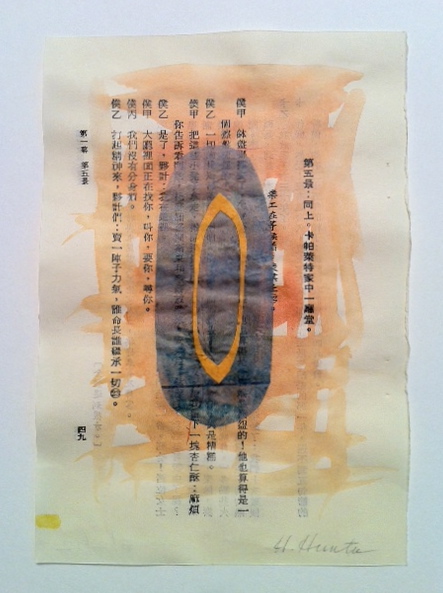
I became fascinated with these internal images and wondered what it might be like to try and express them on paper.

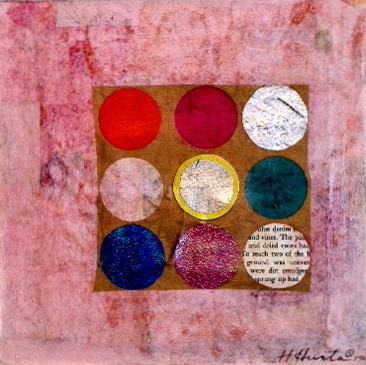
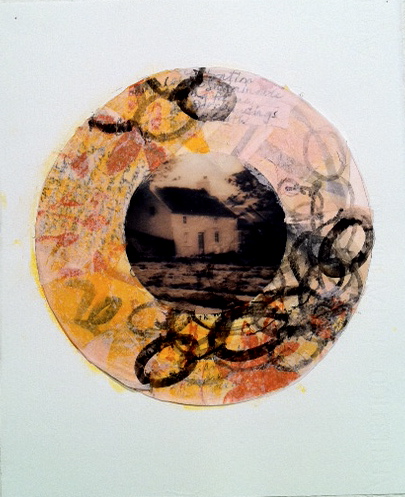
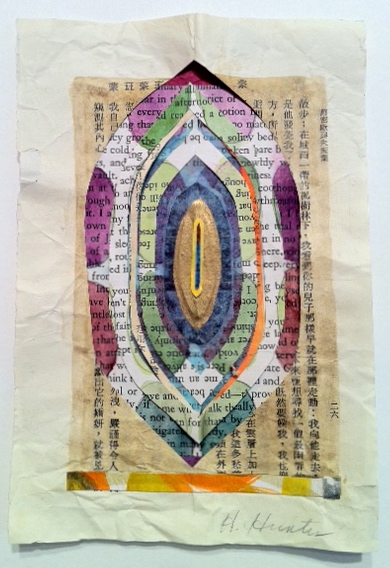
I've been experimenting in the studio for several days now, making 'collage sketches,' trying to elicit these inner images.

Of course, art takes its own direction and as soon as I set about with my intention, an entirely different form showed up. Where these attempts will end up is beyond me, but in the meantime, I'm going to continue to follow the Reiki  thread.
A Light Touch

I've been practicing watercolor for 7 months now, with my teacher, Stacey Vetter. As is my wont, I thought that I'd be seeing certain kinds of results earlier. It doesn't really matter what I'm doing, exercising, studying, making art--I always want things to happen overnight. In this case, I wanted to see how the watercolor painting would transfer over to my collage work.

Luckily, I did notice results with the watercolor, at least enough to keep me going and, just when I'd forgotten about what it was I wanted to happen, it began to do so. I am just beginning to understand how crucial a light touch is.

Previously in my art, I've worked hard to create a series of layers whether it is in fabric, collage, paint or even pencil. I want to show the history of marks, to leave tracks that hint at the evolution of the piece.

Now, as I begin to believe in the power of the light touch, I find myself applying the same process with collage. This morning after adding a layer of gel to a panel, I stood back, gazed at it and stripped away layers that had been softened by the gel. There was a moment that I caught a reflection of the piece's bones and I liked them.

It makes me think of Reiki, that hands on healing technique that we use in the hospital to help with pain and anxiety.

As I hold my hands in different positions on a person's body, I find myself thinking "What I am doing? Is this crazy?" And invariably after I say that to myself, I see the child relaxing, going to sleep, the room quiets and even the parents in the room settle down. One of the patients I worked on described the effects as "smoothing out the wrinkles of pain."--As if while the pain subsides, ripples of relaxation take over.

I can't help but notice the correlation between Reiki and watercolor.  Watercolor too is a smoothing and rippling-the sound and feel of the paint going onto the paper, the shush shush as the brush slides over the soft, stippled paper, brushing on color. And there's something else about the relationship between Reiki and art; both require a light touch. The less you work at it, the better it is.

6 Degrees of Progress

For the past several days, I've been working on a plan for my upcoming workshop: Still Point in a Changing World. My original idea for the workshop was to offer participants an opportunity to spend time in their studios, (whatever their definition of studio might be) on a daily basis for the period of 21 days.

A common notion states that a habit requires 21 days to set. (In actuality, some habits can take longer, but I thought that this time period would be  workable range in people's lives.)

I wanted the studio practice to be akin to a meditation practice; something that they could return to day after day from whatever flurry they found themselves in and locate a point of stillness.

It was inspired too, by my own practice of  watercolor, which I'd conceived in a time of hospital fatigue.

I'd wanted to do something simple, daily and beautiful, with which I could find refreshment, nourishment and tranquility. I found it in the watercolors..

However, I realized that I couldn't just say to workshop participants : "Ok, get yourself a box of watercolors, find something to paint and just keep it up for the next 21 days." Instead, I decided to read about mindfulness and creativity and found myself covered in reference books.

At the same time, the Jewish practice of the Counting the Omer began. (This ancient practice takes place between the holiday of Passover and the later harvest festival of Shavuot).

An artist friend of mine, Laura Hegfield, introduced me to a Facebook page entitled, "A Way In," where Counting the Omer has been re-imagined as an invitation to mindfulness practice: paying attention not only to each day as it passes but also to the individual spiritual qualities which were assigned to it by the 16th century Jewish mystics.

I became fascinated with the simple words and phrases which were offered up each day like a carefully crafted ceramic bowl.

I decided to weave some of the meditations (along with others from a variety of sources) together with prompts for each of the 21 days. Each day of the 21 day workshop will offer a meditation and studio practice for artists to explore.

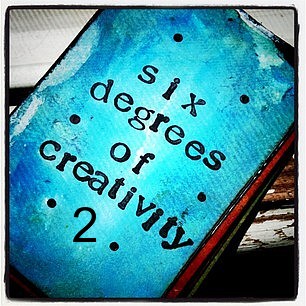
I couldn't wait, so I decided to start experimenting myself.  I'm working on Day 10 and you can see the results above. If you're intrigued, you can register here for my workshop and discover what the rest of the days, and the other five workshops, have to offer.

The Limits of Choice

Art making continually satisfies something deep inside us and, at the same time, places us beyond ourselves. Cathy Malchiodi, The Soul's Palette

Choice of attention - to pay attention to this and ignore that - is to the inner life what choice of action is to the outer.

W.H. Auden

For the last couple of weeks, I've been on a strict 1 color diet. Yes. You read that right; not a 1 calorie diet but a 1 color one.

Color is something I use lavishly in my work, a substance that I immerse myself in and then splash around like a duck.

It's also something in which I easily get lost.

While dipping my brush in color, thinking about the confluence of hues, tints and shades, I lose track of how much paint is loaded on my brush and what color is flowing where.

This came to a head one Friday morning during a watercolor class. Stacey, my instructor, put her hand firmly on the table and said, "O.K., I want you to use just one color for the time being. It doesn't matter what color it is, but you can't mix two together and you can't even mix black." (yes, that indescribably subtle blend of cobalt blue and raw umber...)

OI!, it was already Passover; a week of the matzoh mile and now this: I'm  supposed to restrict myself to one color?

It's been two weeks now and I'm getting used to this diet. Heck, at times, I even like it.

At the very least, it keeps things simple. While writing this post, my eyes lighted on a short interview with researcher, Sheena Iyengar, who wrote The Art of Choosing.  "When did you first have an inkling that choice has limits?" asked the interviewer. Sheena  answered that it happened while studying the effect that choice had on a group of 3-year-olds.

"Half the children were permitted to play with any of the toys in the room, while the other half were told what they could play with. I assumed that the kids with the most freedom to choose would have more fun, right? Wrong. I observed the exact opposite. The assigned group played happily; the free choice group was disengaged and listless."

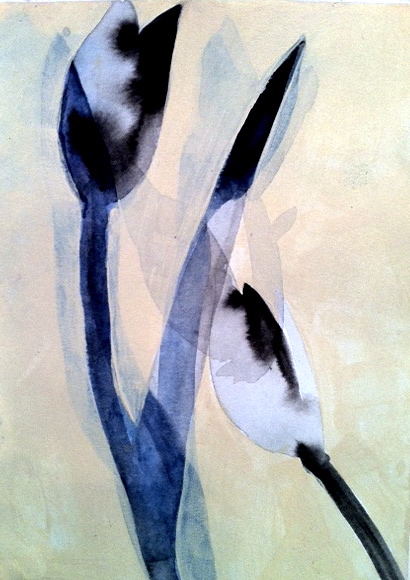
How about that? Adapting to one color has made me anything but disengaged and listless. And there are other payoffs. The first time I get the leaf-to-bud balance just right, the flower in front of me comes alive on the paper.

Despite my kvetching, I'm proud that I am keeping my commitment to a 'year of watercolor'  and grateful for Stacey's steady hand as a teacher and artist.  I may just stay on this new diet for a while...

States of Mind

Last  week I pulled my car into a parking space at the gym. I stayed in the car a few minutes longer to listen to a report on the late journalist, Mike Wallace of 60 Minutes fame, who had died a few days before.

I was struck by his comment made in response to another journalist asking Mike about old age. He had replied that, of course, "it's all down hill from (t)here."  I'm paraphrasing because I can't find the original quote, but those words resounded in my mind over the next several days.

I challenged them-- "that isn't true!"--but I realized something had changed in the person who set off to Europe at 17 by herself and the young woman who created human size nests in her apartment in her twenties.

I tried to figure out what was different, particularly artistically. As a younger person, one confronts a series of firsts. Each new experience can be a source of peak emotion--residue passion that can be channeled zestfully into a new piece of work.

As Twyla Tharp notes in her excellent book,  The Creative Habit, "As we age, it's hard to recapture the recklessness of youth, when new ideas flew off us like light from a pinwheel sparkler. But we more than compensate for this with the ideas we do generate, and with our hard -earned wisdom about how to capture and, more importantly, connect those ideas."

In my fifties, I don't run into many firsts anymore, but there sure are a lot of second chances. And revisions.

I look out my studio window and I'm struck by the the beauty of tree branches with their tightly clustered knots of of budding leaves and their shadows cast  upon the wall of the house. At twenty, I doubt that I would have gotten so much pleasure from such a simple sight, at least not for long. Tharp continues:

"If you find, in your own work, that ideas you didn't have room for at a particular time nonetheless lingered and arose later, you are coming close to an idea creative state, one where creativity becomes a self-perpetuating habit. You are linking your art. Everything in your life feeds into your work, and the work feeds into more work."

This is the beauty of  hanging in there for the long run...I'm nearly two months to the day into my year of watercolor and I'm still painting.  I'm stalking my studio with more ideas than I have time to chase. Irises are blossoming in the garden and outside my studio door, the creeping Hydrangea has reached the second floor after a 16 year climb; a green enclosure for me to contemplate when I step outside. A glorious first after all.