Taking My Own Words to Heart

I grew up and found my purpose and it was to be a physician. My intent wasn't to save the world as much as to heal myself. Few doctors will admit this...but subconsciously, in entering the profession, we must believe that ministering others will heal our woundedness. And it can. But it can also deepen the wounds.

Abraham Verghese, Cutting for Stone

There are times when life becomes a heavy load--patients, tasks, family issues.  I was trying to keep myself glued together as various parts threatened to swirl off, so many fall leaves sucked into the wind and I was stuck in the studio. Odd, because lately the studio was the only place where I wanted to be-- and suddenly, I wasn't comfortable there.

I was going through the motions of art making, pushing pieces of paper together for my collages, fitting them like so many pieces of a jigsaw puzzle, but where was my intention, the focus that brings everything together?

What to do?

How to open my heart? As I sat thinking, I remembered 6 Degrees of Creativity 2. Several people had written about major life transitions they were experiencing. They said that it was difficult to find time and energy to engage in the prompts I'd written for Creating a Mindful Studio Practice.

I urged them to take the prompts slowly; to divide one directive into smaller, more manageable steps. Their responses were heartwarming; I was honored that they were able to take something from what I'd written and apply it to their lives.

Once you’ve chosen a theme/object, write down everything that comes to mind about it, every perspective that you can come up with. DON’T EDIT--USE A STREAM OF CONSCIOUSNESS APPROACH.

Now, take the same object or theme do it again, only this time, write down only the things that interest you about this object.

Look carefully at the two lists and ask yourself what appeals to you about the second list. What you’re going to come up with is your artist thumbprint--your slant on the world. Be mindful AND RESPECTFUL of this-- it will stand you in good stead...

I took up my pen, groaning inwardly, "you mean I have to hand write this??" The odd thing was, as soon as I had my pen in hand and started to write, the grip on my heart began to ease. I took my subject: "Repair" and began to break it down.

By the time I had two lists in front of me, I was feeling whole again. It's funny. Many artists find that sketching their ideas allows them to create an outline, a plan, a clear intent. They create an approximation of what they want to do--paint  a landscape, a portrait, represent an abstract idea. I've always written mine.

Caught up in the difficulty of the cases I was working with at the hospital, I had forgotten how important this step was.

My journal waits for me now on the work table, right up front with the watercolors and I sense where these pieces on "repair" may take me- but more importantly, I've rediscovered the means of writing myself back together again...
Gluebooks On The Move

Normally when we get to this time of the year, I'm thrilled. September is the month of my birth, a time when I feel most comfortable in my skin. The leaves are beginning to yellow and the brilliant light of the Central Valley is edged with a hint of shadows to come. While the weather lived up to it's reputation, September brought a greater than normal share of challenges. I'm pleased to say that while I did my share of "pre-whining,"  (a phrase my sister coined for crossing "troubled waters" before you reach them) I met each one fairly and squarely, but with little time for the studio.

Little time, that is, until a barking good case of bronchitis laid me up for a week. While I was there, I decided to explore Gretchen Miller's workshop, Gluebook Goodness, a part of 6 Degrees of Creativity 2. (I figured I could work on it in bed!)

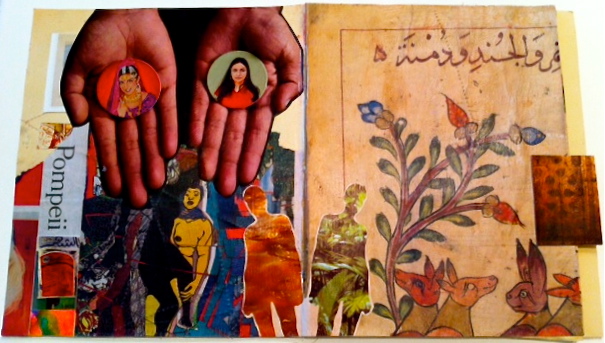
I loved watching Gretchen's hands at work in her video, adding images, words and smudged ink around the edges. I was particularly touched by her encouragement to "dedicate" our gluebooks to particular topics. In her hands, I watched ordinary effluvia such as receipts, tickets and tokens become the diaries of days filled with meaning.

But to what would I dedicate myself and my book? I hunted out receipts and notes around the house, but aside from one that my husband left saying: "Hallie's had hers / Dishwasher mostly emptied" I didn't find any special meanings.

My answer arrived in the form of a Sunday New York Times that my mom dropped off at my house.  It just so happened that this was the issue in which the NY Times Arts section listed all the upcoming exhibits for 2013. I turned to a page filled with Arabic script and saw the words "Crossing Borders: Manuscripts from the Bodleian Libraries."

Eureka! My book would be a tour of all of the exhibits around the country that I want to visit next year. I don't know if I'll get to all of them, but here's a partial list with bonus images:

Crossing Borders: Manuscripts From the Bodleian Libraries at the Jewish Museum, NY, NY (Check out the link above for some fabulous photographs.)

Jasper Johns: Seeing With the Mind's Eye: San Francisco Museum of Modern Art

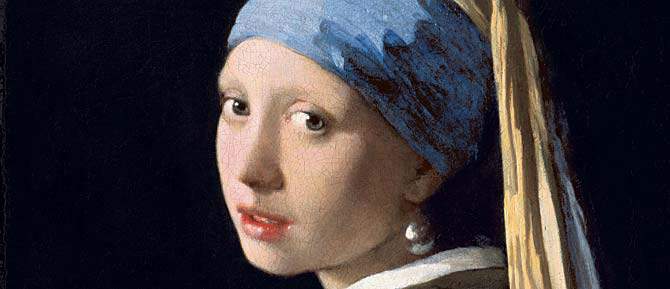
Girl With A Pearl Earring: Dutch Paintings from Mauritshuis: DeYoung Museum, San Francisco

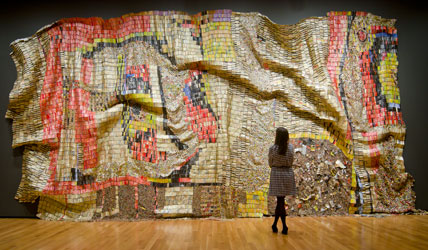
Gravity and Grace: Monumental works by El Anatsui, Brooklyn Museum, NY

I'm curious--what exhibits are on your "must see" list this art season?

I was touched and honored to open up my Gmail yesterday and find this post by Gretchen Miller on "Mindful Studio Practice," my workshop for 6 Degrees of Creativity 2.

Altering an Image

Many years ago in graduate school when Polaroids still existed and the magic of images appearing before your eyes was still new, I enjoyed taking small photos of the sculptures I'd made and altering them with thick, gooey oil pastels--the kind that were an inch wide and 4 inches long and smeared like lipstick.

I savored the challenge of wielding a big stick in a small space-it was a means of gaining control over the uncontrollable. Graduate school was a place where hardball was the rule. Working on these small and intimate scenes returned me to a more comfortable place.

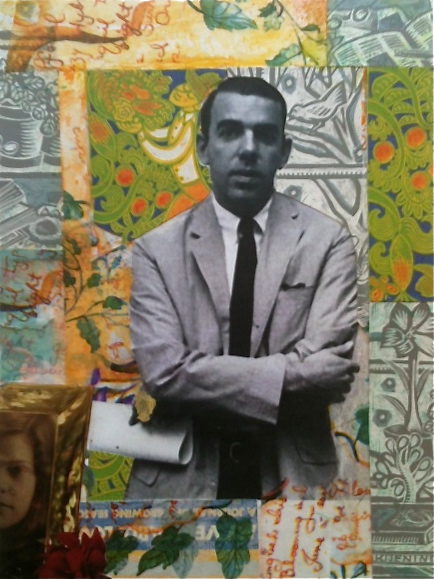
Recently, I've had the opportunity to revisit photo altering in the Altered Image, one of the workshops in 6 Degrees of Creativity 2 taught by Fiona Fitzpatrick, an Australian art therapist. For my project, I chose a photograph my father had emailed to me several weeks ago. In the photo, my father, a young professor, crosses his arms with a roll of papers in his hand. His gaze is expectant, searching, as if looking into the future, wondering what it might bring--and a bit apprehensive at the thought.

As a child, I knew that my dad longed to write. He was an English professor at a Big 10 university, always busy with his classes and busy too, writing the texts from which he taught, but I knew that what he really wanted to do was to write essays. Essays were his favorite form of prose.

Of course, things got in his way as things always do.  I remember wondering if he would achieve his dream and being ignorant of the pleasures of retirement, I feared he might not find the time.

As I held the photograph, I remembered all this--and the recognition of all that has taken place since his retirement. My dad, Carl Klaus, is 80. He has written 6 books since retirement, his Mac on fire with all that he stored up to say.  It was this blossoming of words that I wanted to express as I altered the image of the writer as a younger man.

I wanted to take that figure and surround him with the fruits of his labor; fruits that he couldn't possibly see from his perspective in time, but that certainly, in due time, were his to harvest.

I took postcards announcing the publication of two of his early books and cut them into slices, encircling him so that he appears to be at the center of an illuminated manuscript. I tucked a picture of Kate, his second wife, into the corner. Her death became the subject of another book: Letters to Kate.

As I glued, painted and pressed papers onto the surface, I was transported by the process of juxtaposing past with present in the same picture.

I took a break in the middle of the process and checked my e-mail. There was an e-mail from my dad. While I'd been working on his collage, he'd typed a message: "...the attachment is the manuscript for my new book, which I just finished yesterday afternoon...I thought you might be interested... on the chance that it might give you some ideas you can use in the writing you do for your blog, for your art, for your professional work, for your personal satisfaction.

Mysterious, isn't it, how altering an image can affect your life in an unexpected way?