Pocket Change: Or, Small (Creative) Acts Create Meaningful Change

"Even after they are cut down, a sprout may be taken from them and planted in another place, and they begin to grow again." —Mishna

Pocket Change, Badge created by Gretchen Miller

Like a lot of people I know, I've been searching for meaning among the rubble of recent events; both inside our country and out of it.

Though it is easier but necessary, to critique what is going wrong in our schools, our homes, and our countries, I wanted to stretch a little and find a project which contributes to the good in a small but meaningful way.

It began with an idea from my friend, Beth Rommel, who wanted  begin the new year with something positive, something with art, something with others.

In collaboration with Gretchen Miller and myself, we concocted Pocket Change, hosted by 6 Degrees of Creativity.

Pocket Change’s intention is to focus on the concept of creating change through making something small (in the form of artist trading cards) to exchange with one another, as well as to encourage simple acts of creative kindness with others.

I decided to try out making a few of the cards. They were fun to create--simple, without encumbrance. They remind me of mandarin oranges. You pick one up, peel it and pop it whole, or in a few sections, into your mouth and suck out the sweetness.

photo-4

photo-1

photoPocket Change is all about how simple and small acts can create and instill kindness, gratitude, and change.  Think about the power of your mini artworks as a means to express and share a positive image, message, or intention with others (and the world!) that can make a difference, bring hope, or inspiration.

-Gretchen Miller

It reminds me of the Mindful Studio Practice that I offered as part of 6 Degrees of Creativity 2. The beauty of making artist trading cards is the opportunity for quiet moments in which your imagination can stretch.

But wait, there's more: the added bonus of sending these miniatures off so that someone else will benefit from your practice.

Please join us for some pocket size creative goodness and kindness to share with one another and others!  The deadline to sign up for the ATC exchange is January 15.  Learn more about the exchange details and how to get involved on the 6 Degrees of Creativity blog.

"Caring for children...our first job"*

"Holding the Light" ©2010, H. Hunter, 5" x 8", SoulCollage® Lately, it's been a Charles Dickens kind of time. You know, that line from  The Tale of Two Cities:

It was the best of times, it was the worst of times, it was the age of wisdom, it was the age of foolishness, it was the epoch of belief, it was the epoch of incredulity, it was the season of Light, it was the season of Darkness, it was the spring of hope, it was the winter of despair, we had everything before us, we had nothing before us, we were all going direct to Heaven, we were all going direct the other way..."

These words, written by Dickens in 1859, 153 years ago, speak worlds about today. When I juxtapose the lights of Chanukah and Christmas against the carnage in Connecticut, I wonder how we can comprehend this paradox of light and dark. I don't know.

I took heart as I listened to President Obama speak at the memorial service for the 20 souls of the children and souls of the 6 adults.

"This is our first task -- caring for our children. It’s our first job. If we don’t get that right, we don’t get anything right. That’s how, as a society, we will be judged.

And by that measure, can we truly say, as a nation, that we are meeting our obligations?...I’ve been reflecting on this the last few days, and if we’re honest with ourselves, the answer is no. We’re not doing enough. And we will have to change."

That is a call to action if I ever heard one and it makes me take a closer look at my immediate world.

It's easy to become desensitized working as an art therapist in a hospital--every day--a census filled with names, ages, diagnoses.

Lately that census has included more than one child who wasn't adequately cared for; whose parents didn't meet their obligation and left them untended, unfed, or even worse, dropped or shaken.

My mind cannot contain the range of extreme thoughts which arise, watching a toddler careen around the playroom sporting an NFL-size helmet for self-protection.

Often, due to brain injuries, these children have little or no impulse control, so put away those crayons and markers art therapist, it's time to get moving.

The task becomes following them, holding them, talking to them, playing with them, getting down on the ground and dancing with them and in every way that I can, loving them.

In this new year to come, I challenge us all to take one small step toward the goal of caring for all of our children. What might that be? Taking time to listen, really listen when a child speaks, (put down the cell phone already!), donating time or money to an organization that brings aid to children, reading to a child, mentoring one, teaching a class at a local art center or finding a school that needs your aid.

There’s only one thing we can be sure of, and that is the love that we hold -- for our children, for our families, for each other. The warmth of a little one’s embrace -- the best cure for the worst of times.

*President Obama in his address to Newtown CT, 12/17/12.

Winter Wisdom

Mindfulness at Play "Art expression itself is a way of creating something new from what you already have, but may not have fully recognized within yourself.” Cathy Malchiodi

The other day I received a newsletter from my art therapist friend Lisa Mitchell.

She's constructed a new series of workshops, including a vision board* workshop--and not just any old vision board workshop. Her descriptions note that, by using ordinary materials in unusual ways and learning new techniques, our intentions are solidified. In the process, our brain gets a workout using all our senses. The point is to bring our abstract ideas and dreams into the realm of the concrete and plausible, by incorporating them into the board.

That got me thinking about my own vision board, which I wrote about in a post, "Mindfulness at Play," at the beginning of the year. I decided to go back to the board and see what has come to pass.

As I look at the board, I see a large, peaceful Buddha's head framed by conifers and plants that remind me of our winter foliage here in California. Underneath the Buddha, from left to right, children hold a board filled with artist trading cards. To the right of the children a yoga class takes place. A teacher is helping a student with a pose.

In my post, I said that I wanted to deepen my art therapy practice; to become more present with the children, even as my own are grown. And I wanted, although I didn't write it, to have a steady yoga practice.

What's odd is that both of these desires have come to pass, but not by deliberate intention. The vision board hung on my studio wall, where it watched over me and I looked at it, day after day, while a year passed.

It has not been a straight path back to yoga--(is it ever?) Like Goldilocks, first I sampled the "big bowl," a class at our University gym. I was the oldest participant and the class, a Viniyasa practice, and I felt like I'd just had an aerobic  workout, not a yoga class.

Next, for my "middle size bowl," I tried a class offered through our hospital. The instructor offered peacefulness with a pale green scented candle. I ended up with a migraine.

Finally, for a bowl that is just right. The solution came in an unexpected fashion. Both my daughter and my sister have recently been diagnosed with auto-immune diseases that make certain movements difficult.

I remembered yet another yoga class I'd taken the previous year for people 55 and over. Led by the fearless and inimitable, Hana Raftery, majoring in exercise physiology, she had every one of us, from me to the oldest 80- something moving with ease.

I e-mailed her and set up a private lesson for my daughter and me. I invited my sister, who suggested we have it in her new house, which has a wooden floor, but would be empty for another month. Shazaam! A yoga studio!

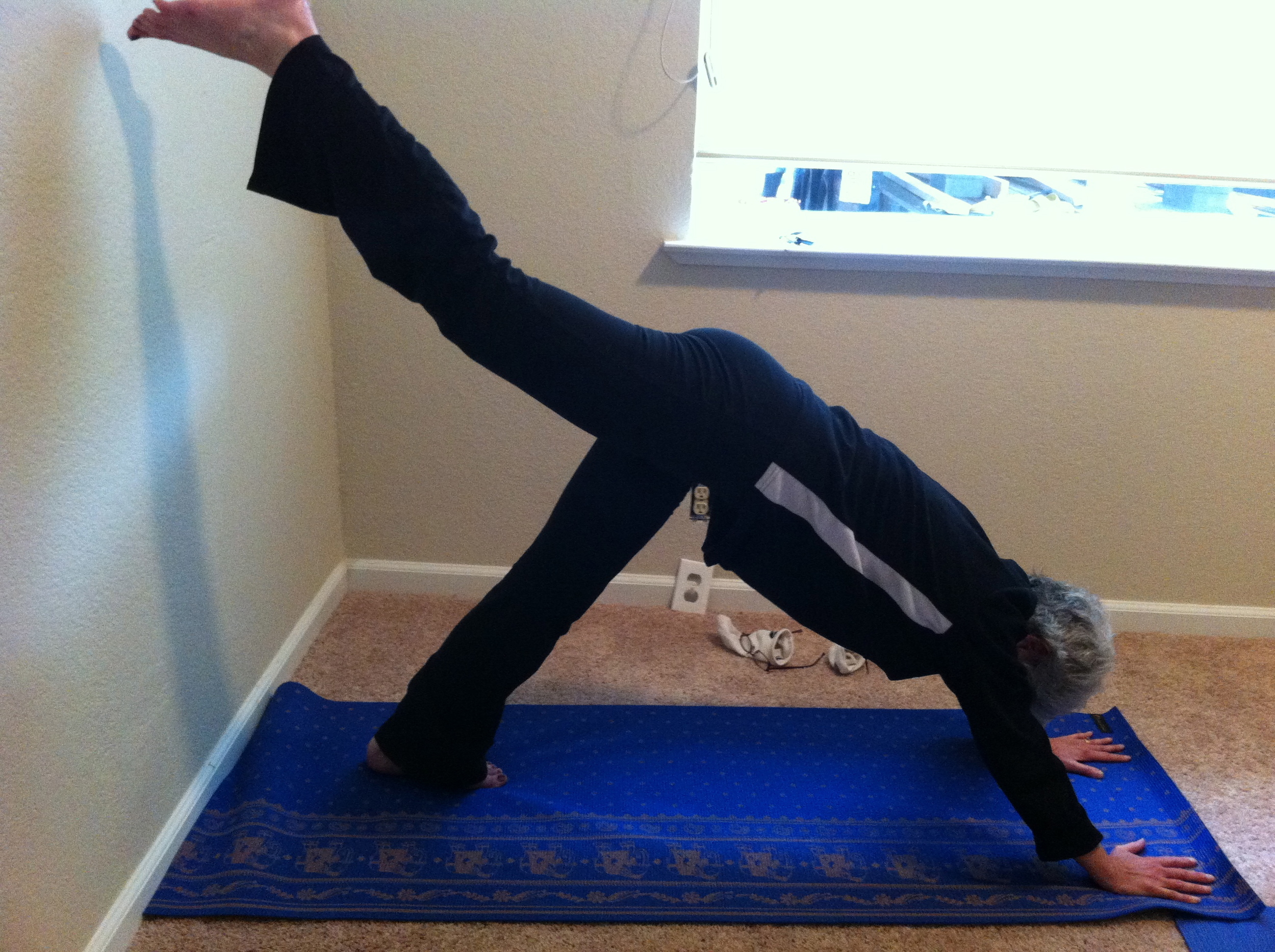
Downward dog pose

We began by meeting once a week and now have increased it to 2 times. We've been meeting since before Thanksgiving and even though the two of them are still waiting for their respective rheumatology consults, their movements are coming more easily.

I am in hog heaven, if you can say that about a yoga class. I feel like I really have found the bowl that is "just right." And it all started with a small 8.5 x 11 vision board.

I'm looking forward to making my 2013 vision board soon and I invite you to join me and make your own. Who knows, those dreams might just be waiting for an invitation to come out and play!

*A vision board is usually a piece of matte board on which you paste or collage images that you’ve torn out from various magazines. The intention behind the vision boards is the notion that when you surround your self with images of what you want to develop or change, your life changes to fit the images.

Phase Transition*

Yesterday I had the strange honor of sitting beside a beautiful young woman who was literally pulling her hair out. I didn't understand what was happening at first. I was getting to know her and she was getting to know me, as well as what I do in the hospital. We spoke of her illness, of the fact that her hair was falling out (she didn't want it shaved), of the cartoons playing on the television. The entire time we talked, she pulled at strands of her hair, twirling small bits,  and calmly yanked them out, putting them carefully on the coverlet.

By the time I left the room, she had tucked a considerable amount of what had once covered her head into a plastic sandwich bag for safekeeping.

It was one of those scenes that goes in so deep, I wanted to run away and cry. I had an art group to facilitate, so instead, I went back to my office and stared at the wall of orderly art supplies, the bottles and tubes of color lining the shelves bringing me comfort.

I've been thinking a lot about repair; how to reconstitute myself after being torn in so many different directions all day long. Inspired by comments on this blog, from my family and local friends, I've been thinking about my art work, it's purpose and relation to the art therapy.

I'm always trying to find a "balance"--somehow comprehend the relationship of making art to practicing art therapy, but both are subtle practices and too mysterious to hold onto all at once. Instead, I've begun to think of the two as intertwined, a kind of ongoing tapestry, in which each activity informs the texture and direction of the other.

Since trying this approach, I've felt more relaxed and present (that ever present word : "present"!)

I've found myself describing my art work as a way to restore a sense of calm amidst the overwhelming flux surrounding me. I've often thought of art making and art therapy as forms of Tikkun O'lam, a Jewish phrase that means "repair of the world." What I've most recently come to appreciate again, is that while practicing both arts, I am repairing myself too! (Well, heck, I knew that, but I guess it's just on a deeper level this time!)

I've continued to adapt patchwork quilting to paper and instead of putting diverse fabrics together to form a beautiful pattern, I take sections and bits of paintings along with pieces of collected paper and put them together into patterns--with the patterns signifying more than the surface beauty. They attempt to fuse the variety of experience together into a whole. The process of the work is soothing and at the same time frustrating. I paint, cut out a square, cover a small area and then immediately tear off other areas of the work, then repeat the whole process again.

It's stretching me, this work, not letting me become complacent. Each new section has its own internal direction but is also patient, waiting quietly for me to discover what it is and turn to it--again and again.

* A "phase transition" is the process by which matter transforms via a thermodynamic system from one phase or state of matter to another.

Good News: Art Therapy and Healthcare just published!

Lately, my mind has been wandering; wondering what it would be like to attend my 40th high school reunion, and whether it would be fun or feel like torture. Meanwhile our fall Young Adult Bereavement Art Group (YABAG) was advancing in fits and starts and now has finally fallen into a rhythm, much as leaves progress into their rich autumn colors.

Sometimes it takes a while for a group to coalesce, like the leaves of particular trees turning at different times. In a group where participants have suffered devastating loss (all loss is devastating, but some circumstances can bring additional trauma to the bereaved), people need time to make sense of their lives going forward.

My colleague and I wondered what was going on; perhaps it was how we were leading the group, but we reminded ourselves we'd done this many times before with the same curriculum and it had worked.

As if to remind us of this, two thick cardboard envelopes arrived in the campus mail, one addressed to me and the other to my colleague. I can't tell you if he ripped his envelope open, but had I been there when they arrived, I would have!

Inside the brown husk of wrapper lay the fruit of our labors for the last year; a copy of Cathy Malchiodi's edited and recently published book: Art Therapy and Healthcare, containing our chapter on the young adult bereavement art group. When I saw the cover, a richly colored oil pastel nautilus drawn by Cathy, I felt such a swelling of pride; as if some unspoken, barely imagined dream had come to pass.

I've had a chance to cozy up with it and I'm looking forward to reading through the many chapters written by art therapists across the country and world. I'm reminded of a colored construction paper banner that hung in my public library as a child. The letters read: "Come, journey with a book." I know I will.